Pages

Showing posts with label poetry. Show all posts

February 13, 2014

'ZAP!!' by eLPy

I get to hang in South Africa today! The stop on the How to Be a Man Virtual Book Tour today is at Eclipse Reviews.  Not every day you get to take part in a Book Blast!  Thank you so much, Janine! 

(via)

I’ve been reading That Which Lives Within, the poetry collection by eLPy, a friend of mine.  I just had to share.  I love this one for its playfulness, assonance, and enjambment.  It combines a lighthearted conceit with deadly seriousness. Thanks, eLPy!

ZAP!!

by eLPy

laps
things don’t fall in laps
except maybe lapses
in judgement, in time
relapses in addictions
afflictions, predispositions
of some form or
many others
whatever secrets under cover
keep you up
like a hover craft
you never land, never grounded
gotta keep far from that
undiscovered, uncovered but
never elusive, all inclusive
quicksand
it doesn’t all come real quick
and as easy as it is
to slip, so you know.
you’ll fall before it falls
into your lap
your brain’s got more substance
than that
try and put it to use
while you’re waiting
for that something to fall
into your lap
I bet then, you’ll feel the
lightning              ZAP!

January 3, 2014

'Written by Zen Monks and Haiku Poets on the Verge of Death'

Thinking about how we transmute our lives and our pain into words on a page (a la NPR).

(via)
Chiboku

Died on the twenty-eighth day of the fifth month, 1740 at the age of forty-four

The running stream
is cool—the pebbles
underfoot.


via Japanese Death Poems

December 5, 2013

'Argos' by Michael Collier

I love this poem.

(via)


ARGOS
by Michael Collier

If you think Odysseus too strong and brave to cry,
that the god-loved, god-protected hero
when he returned to Ithaka disguised,
intent to check up on his wife

and candidly apprize the condition of his kingdom,
steeled himself resolutely against surprise
and came into his land cold-hearted, clear-eyed,
ready for revenge--then you read Homer as I did,

too fast, knowing you'd be tested for plot
and major happenings, skimming forward to the massacre,
the shambles engineered with Telemakhos
by turning beggar and taking up the challenge of the bow.

Reading this way you probably missed the tear
Odysseus shed for his decrepit dog, Argos,
who's nothing but a bag of bones asleep atop
a refuse pile outside the palace gates. The dog is not

a god in earthly clothes, but in its own disguise
of death and destitution is more like Ithaka itself.
And if you returned home after twenty years
you might weep for the hunting dog

you long ago abandoned, rising from the garbage
of its bed, its instinct of recognition still intact,
enough will to wag its tail, lift its head, but little more.
Years ago you had the chance to read that page more closely

but instead you raced ahead, like Odysseus, cocksure
with your plan. Now the past is what you study,
where guile and speed give over to grief so you might stop,
and desiring to weep, weep more deeply.

February 13, 2013

'The Red Wheelbarrow' by William Carlos Williams

Just because.

(via)
The Red Wheelbarrow

by William Carlos Williams

so much depends
upon

a red wheel
barrow

glazed with rain
water

beside the white
chickens.

January 28, 2013

'To Lucy in London,' by Bob Torry

Apparently there was just one of Bob's poems published ~ here at UW in UWyo Magazine in 2001.  I'm so glad I was able to find it.  Here it is, but know that an editor changed one word of the poem over Bob's objections.  I don't know which one, though.


(via)

To Lucy in London

by Robert L. Torry

Upheld in mountain towns we wait
as other, timely, towns below
accept consignment of the freight
that spring delivers when the snow
in every yard's account is spent.
While lower trees expand in green
fir trees are chaste, restrained. They mean
to save for weeks their warm assent.
You tell me London too is cold,
with winter after April old
as stone. Yet you yourself display
long winter's sense in this delay:
gray garden walls around disclose
the luminescence of the rose.

January 23, 2013

'One Today,' by Richard Blanco

The amazing Inauguration Day poem, "One Today" by Richard Blanco.


One Today

by Richard Blanco

One sun rose on us today, kindled over our shores,
peeking over the Smokies, greeting the faces
of the Great Lakes, spreading a simple truth
across the Great Plains, then charging across the Rockies.
One light, waking up rooftops, under each one, a story
told by our silent gestures moving behind windows.

My face, your face, millions of faces in morning's mirrors,
each one yawning to life, crescendoing into our day:
pencil-yellow school buses, the rhythm of traffic lights,
fruit stands: apples, limes, and oranges arrayed like rainbows
begging our praise. Silver trucks heavy with oil or paper—
bricks or milk, teeming over highways alongside us,
on our way to clean tables, read ledgers, or save lives—
to teach geometry, or ring-up groceries as my mother did
for twenty years, so I could write this poem.

All of us as vital as the one light we move through,
the same light on blackboards with lessons for the day:
equations to solve, history to question, or atoms imagined,
the "I have a dream" we keep dreaming,
or the impossible vocabulary of sorrow that won't explain
the empty desks of twenty children marked absent
today, and forever. Many prayers, but one light
breathing color into stained glass windows,
life into the faces of bronze statues, warmth
onto the steps of our museums and park benches
as mothers watch children slide into the day.

One ground. Our ground, rooting us to every stalk
of corn, every head of wheat sown by sweat
and hands, hands gleaning coal or planting windmills
in deserts and hilltops that keep us warm, hands
digging trenches, routing pipes and cables, hands
as worn as my father's cutting sugarcane
so my brother and I could have books and shoes.

The dust of farms and deserts, cities and plains
mingled by one wind—our breath. Breathe. Hear it
through the day's gorgeous din of honking cabs,
buses launching down avenues, the symphony
of footsteps, guitars, and screeching subways,
the unexpected song bird on your clothes line.

Hear: squeaky playground swings, trains whistling,
or whispers across café tables, Hear: the doors we open
for each other all day, saying: hello, shalom,
buon giorno, howdy, namaste, or buenos días
in the language my mother taught me—in every language
spoken into one wind carrying our lives
without prejudice, as these words break from my lips.

One sky: since the Appalachians and Sierras claimed
their majesty, and the Mississippi and Colorado worked
their way to the sea. Thank the work of our hands:
weaving steel into bridges, finishing one more report
for the boss on time, stitching another wound
or uniform, the first brush stroke on a portrait,
or the last floor on the Freedom Tower
jutting into a sky that yields to our resilience.

One sky, toward which we sometimes lift our eyes
tired from work: some days guessing at the weather
of our lives, some days giving thanks for a love
that loves you back, sometimes praising a mother
who knew how to give, or forgiving a father
who couldn't give what you wanted.

We head home: through the gloss of rain or weight
of snow, or the plum blush of dusk, but always—home,
always under one sky, our sky. And always one moon
like a silent drum tapping on every rooftop
and every window, of one country—all of us—
facing the stars
hope—a new constellation
waiting for us to map it,
waiting for us to name it—together.


And, if you'd like to see him read it:


January 17, 2013

'For I Will Consider My Cat Jeoffry,' by Christopher Smart

I came across a quote the other day that I love: "Poetry is for those things you have no words for."  So I thought I'd post a poem today that I read in my first poetry survey course that I loved.  I even did a take-off on it called, "My Cat Flip."

(via)


For I Will Consider My Cat Jeoffry

by Christopher Smart

For I will consider my Cat Jeoffry.
For he is the servant of the Living God duly and daily serving him.
For at the first glance of the glory of God in the East he worships in his way.
For this is done by wreathing his body seven times round with elegant quickness.
For then he leaps up to catch the musk, which is the blessing of God upon his prayer.
For he rolls upon prank to work it in.
For having done duty and received blessing he begins to consider himself.
For this he performs in ten degrees.
For first he looks upon his forepaws to see if they are clean.
For secondly he kicks up behind to clear away there.
For thirdly he works it upon stretch with the forepaws extended.
For fourthly he sharpens his paws by wood.
For fifthly he washes himself.
For sixthly he rolls upon wash.
For seventhly he fleas himself, that he may not be interrupted upon the beat.
For eighthly he rubs himself against a post.
For ninthly he looks up for his instructions.
For tenthly he goes in quest of food.
For having consider'd God and himself he will consider his neighbour.
For if he meets another cat he will kiss her in kindness.
For when he takes his prey he plays with it to give it a chance.
For one mouse in seven escapes by his dallying.
For when his day's work is done his business more properly begins.
For he keeps the Lord's watch in the night against the adversary.
For he counteracts the powers of darkness by his electrical skin and glaring eyes.
For he counteracts the Devil, who is death, by brisking about the life.
For in his morning orisons he loves the sun and the sun loves him.
For he is of the tribe of Tiger.
For the Cherub Cat is a term of the Angel Tiger.
For he has the subtlety and hissing of a serpent, which in goodness he suppresses.
For he will not do destruction, if he is well-fed, neither will he spit without provocation.
For he purrs in thankfulness, when God tells him he's a good Cat.
For he is an instrument for the children to learn benevolence upon.
For every house is incomplete without him and a blessing is lacking in the spirit.
For the Lord commanded Moses concerning the cats at the departure of the Children of Israel from Egypt.
For every family had one cat at least in the bag.
For the English Cats are the best in Europe.
For he is the cleanest in the use of his forepaws of any quadruped.
For the dexterity of his defence is an instance of the love of God to him exceedingly.
For he is the quickest to his mark of any creature.
For he is tenacious of his point.
For he is a mixture of gravity and waggery.
For he knows that God is his Saviour.
For there is nothing sweeter than his peace when at rest.
For there is nothing brisker than his life when in motion.
For he is of the Lord's poor and so indeed is he called by benevolence perpetually--Poor Jeoffry! poor Jeoffry! the rat has bit thy throat.
For I bless the name of the Lord Jesus that Jeoffry is better.
For the divine spirit comes about his body to sustain it in complete cat.
For his tongue is exceeding pure so that it has in purity what it wants in music.
For he is docile and can learn certain things.
For he can set up with gravity which is patience upon approbation.
For he can fetch and carry, which is patience in employment.
For he can jump over a stick which is patience upon proof positive.
For he can spraggle upon waggle at the word of command.
For he can jump from an eminence into his master's bosom.
For he can catch the cork and toss it again.
For he is hated by the hypocrite and miser.
For the former is afraid of detection.
For the latter refuses the charge.
For he camels his back to bear the first notion of business.
For he is good to think on, if a man would express himself neatly.
For he made a great figure in Egypt for his signal services.
For he killed the Ichneumon-rat very pernicious by land.
For his ears are so acute that they sting again.
For from this proceeds the passing quickness of his attention.
For by stroking of him I have found out electricity.
For I perceived God's light about him both wax and fire.
For the Electrical fire is the spiritual substance, which God sends from heaven to sustain the bodies both of man and beast.
For God has blessed him in the variety of his movements.
For, tho he cannot fly, he is an excellent clamberer.
For his motions upon the face of the earth are more than any other quadruped.
For he can tread to all the measures upon the music.
For he can swim for life.
For he can creep. 

December 5, 2012

'Meditation XVII' by John Donne

In a dark mood, and so a poem.


Four Horsemen of Apocalypse, by Viktor Vasnetsov (1887) (via)

Excerpt from "Meditation XVIII"

by John Donne

No man is an island, entire of itself; every man is a piece of the continent, a part of the main; if a clod be washed away by the sea, Europe is the less, as well as if a promontory were, as well as if a manor of thy friend's or of thine own were; any man's death diminishes me, because I am involved in mankind, and therefore never send to know for whom the bell tolls; it tolls for thee.

November 12, 2012

In Honor of Veteran's Day and All Who Served

In honor of Veteran's Day and all those who served, an amazing painting and an amazing poem.


Soldier, by Adi Nes

Dulce et Decorum Est
by Wilfred Owen
Bent double, like old beggars under sacks,
Knock-kneed, coughing like hags, we cursed through sludge,
Till on the haunting flares we turned our backs
And towards our distant rest began to trudge.
Men marched asleep. Many had lost their boots
But limped on, blood-shod. All went lame; all blind;
Drunk with fatigue; deaf even to the hoots
Of tired, outstripped Five-Nines that dropped behind.

Gas! GAS! Quick, boys! -- An ecstasy of fumbling,
Fitting the clumsy helmets just in time;
But someone still was yelling out and stumbling
And flound'ring like a man in fire or lime . . .
Dim, through the misty panes and thick green light,
As under I green sea, I saw him drowning.

In all my dreams, before my helpless sight,
He plunges at me, guttering, choking, drowning.

If in some smothering dreams you too could pace
Behind the wagon that we flung him in,
And watch the white eyes writhing in his face,
His hanging face, like a devil's sick of sin;
If you could hear, at every jolt, the blood
Come gargling from the froth-corrupted lungs,
Obscene as cancer, bitter as the cud
Of vile, incurable sores on innocent tongues, --
My friend, you would not tell with such high zest
To children ardent for some desperate glory,
The old lie: Dulce et decorum est
Pro patria mori.

August 28, 2012

'When I Consider How My Light Is Spent,' by John Milton


I'm taking my mom to get her second eye cataract surgery done, which was making me think about losing one's vision, and that would in my case also make me lose my art, so today, a little Milton.


John Milton (via)


When I Consider How My Light Is Spent
 
by John Milton
 
When I consider how my light is spent,
   Ere half my days in this dark world and wide,
   And that one talent which is death to hide
Lodged with me useless, though my soul more bent
To serve therewith my Maker, and present
   My true account, lest He returning chide;
   "Doth God exact day-labor, light denied?"
I fondly ask. But Patience, to prevent
That murmur, soon replies, "God doth not need
   Either man's work or His own gifts. Who best
   Bear His mild yoke, they serve Him best. His state
Is kingly: thousands at His bidding speed,
   And post o'er land and ocean without rest;
   They also serve who only stand and wait."

July 23, 2012

English Don't Make Sense

My friend Mike posted this for me on Facebook.  Love it! Boy, it takes concentration, though.


Via

"The Chaos" is a poem that demonstrates the irregularity of English spelling and pronunciation, written by Dutch writer, traveller, and teacher Gerard Nolst Trenité (1870-1946), also known under the pseudonym Charivarius.

The preface: "If you can pronounce correctly every word in this poem, you will be speaking English better than 90% of the native English speakers in the world. After trying the verses, a Frenchman said he’d prefer six months of hard labor to reading six lines aloud."

The Chaos

by Gerard Nolst Trenite

Dearest creature in creation,
Study English pronunciation.
I will teach you in my verse
Sounds like corpse, corps, horse, and worse.
I will keep you, Suzy, busy,
Make your head with heat grow dizzy.
Tear in eye, your dress will tear.
So shall I! Oh hear my prayer.
Just compare heart, beard, and heard,
Dies and diet, lord and word,
Sword and sward, retain and Britain.
(Mind the latter, how it’s written.)
Now I surely will not plague you
With such words as plaque and ague.
But be careful how you speak:
Say break and steak, but bleak and streak;
Cloven, oven, how and low,
Script, receipt, show, poem, and toe.
Hear me say, devoid of trickery,
Daughter, laughter, and Terpsichore,
Typhoid, measles, topsails, aisles,
Exiles, similes, and reviles;
Scholar, vicar, and cigar,
Solar, mica, war and far;
One, anemone, Balmoral,
Kitchen, lichen, laundry, laurel;
Gertrude, German, wind and mind,
Scene, Melpomene, mankind.
Billet does not rhyme with ballet,
Bouquet, wallet, mallet, chalet.
Blood and flood are not like food,
Nor is mould like should and would.
Viscous, viscount, load and broad,
Toward, to forward, to reward.
And your pronunciation’s OK
When you correctly say croquet,
Rounded, wounded, grieve and sieve,
Friend and fiend, alive and live.
Ivy, privy, famous; clamour
And enamour rhyme with hammer.
River, rival, tomb, bomb, comb,
Doll and roll and some and home.
Stranger does not rhyme with anger,
Neither does devour with clangour.
Souls but foul, haunt but aunt,
Font, front, wont, want, grand, and grant,
Shoes, goes, does. Now first say finger,
And then singer, ginger, linger,
Real, zeal, mauve, gauze, gouge and gauge,
Marriage, foliage, mirage, and age.
Query does not rhyme with very,
Nor does fury sound like bury.
Dost, lost, post and doth, cloth, loth.
Job, nob, bosom, transom, oath.
Though the differences seem little,
We say actual but victual.
Refer does not rhyme with deafer.
Fe0ffer does, and zephyr, heifer.
Mint, pint, senate and sedate;
Dull, bull, and George ate late.
Scenic, Arabic, Pacific,
Science, conscience, scientific.
Liberty, library, heave and heaven,
Rachel, ache, moustache, eleven.
We say hallowed, but allowed,
People, leopard, towed, but vowed.
Mark the differences, moreover,
Between mover, cover, clover;
Leeches, breeches, wise, precise,
Chalice, but police and lice;
Camel, constable, unstable,
Principle, disciple, label.
Petal, panel, and canal,
Wait, surprise, plait, promise, pal.
Worm and storm, chaise, chaos, chair,
Senator, spectator, mayor.
Tour, but our and succour, four.
Gas, alas, and Arkansas.
Sea, idea, Korea, area,
Psalm, Maria, but malaria.
Youth, south, southern, cleanse and clean.
Doctrine, turpentine, marine.
Compare alien with Italian,
Dandelion and battalion.
Sally with ally, yea, ye,
Eye, I, ay, aye, whey, and key.
Say aver, but ever, fever,
Neither, leisure, skein, deceiver.
Heron, granary, canary.
Crevice and device and aerie.
Face, but preface, not efface.
Phlegm, phlegmatic, ass, glass, bass.
Large, but target, gin, give, verging,
Ought, out, joust and scour, scourging.
Ear, but earn and wear and tear
Do not rhyme with here but ere.
Seven is right, but so is even,
Hyphen, roughen, nephew Stephen,
Monkey, donkey, Turk and jerk,
Ask, grasp, wasp, and cork and work.
Pronunciation (think of Psyche!)
Is a paling stout and spikey?
Won’t it make you lose your wits,
Writing groats and saying grits?
It’s a dark abyss or tunnel:
Strewn with stones, stowed, solace, gunwale,
Islington and Isle of Wight,
Housewife, verdict and indict.
Finally, which rhymes with enough,
Though, through, plough, or dough, or cough?
Hiccough has the sound of cup.
My advice is to give up!!!

July 19, 2012

'Sick,' by Shel Silverstein

I'm not feeling quite up to snuff today, so in honor of that, one of my favorite Shel Silverstein poems.

Via

Sick

by Shel Silverstein

"I cannot go to school today,"
Said little Peggy Ann McKay.
"I have the measles and the mumps,
A gash, a rash and purple bumps.
My mouth is wet, my throat is dry,
I'm going blind in my right eye.
My tonsils are as big as rocks,
I've counted sixteen chicken pox
And there's one more--that's seventeen,
And don't you think my face looks green?
My leg is cut--my eyes are blue--
It might be instamatic flu.
I cough and sneeze and gasp and choke,
I'm sure that my left leg is broke--
My hip hurts when I move my chin,
My belly button's caving in,
My back is wrenched, my ankle's sprained,
My 'pendix pains each time it rains.
My nose is cold, my toes are numb.
I have a sliver in my thumb.
My neck is stiff, my voice is weak,
I hardly whisper when I speak.
My tongue is filling up my mouth,
I think my hair is falling out.
My elbow's bent, my spine ain't straight,
My temperature is one-o-eight.
My brain is shrunk, I cannot hear,
There is a hole inside my ear.
I have a hangnail, and my heart is--what?
What's that? What's that you say?
You say today is. . .Saturday?
G'bye, I'm going out to play!"

July 9, 2012

'Tree Marriage,' by William Meredith

The other day, Garrison Keillor featured this poem on The Writer’s Almanac. I just love it.

Via

Tree Marriage


In Chota Nagpur and Bengal
the betrothed are tied with threads to
mango trees, they marry the trees
as well as one another, and
the two trees marry each other.
Could we do that some time with oaks
or beeches? This gossamer we
hold each other with, this web
of love and habit is not enough.
In mistrust of heavier ties,
I would like tree-siblings for us,
standing together somewhere, two
trees married with us, lightly, their
fingers barely touching in sleep,
our threads invisible but holding.

June 26, 2012

'I Feel A Change Comin' On' by Bob Dylan

Since we're doing cool poetry, how about a little Bob Dylan today?  In honor of me moving offices from one floor to another.

Via

I Feel A Change Comin' On

by Bob Dylan


Well I'm lookin the world over
Looking far off into the east
And i see my baby comin'
She's walking with the village beast
I feel a change comin' on
And the last part of the day's already gone

We got so much in common
We strive for the same old ends
And I just can't wait
Wait for us to become friends
I feel a change comin' on
And the fourth part of the day's already gone

Well life is for love
And they say that love is blind
If you wanna live easy
Baby, pack your clothes with mine
I feel a change comin' on
And the fourth part of the day's already gone

Well now what's the use in dreaming
You got better things to do
Dreams never did work for me anyway
Even when they did come true

You are as porous as ever
Baby you can start a fire
I must be losing my mind
You're the object of my desire
I feel a change comin' on
And the fourth part of the day's already gone

I'm listening to Billy Joe Shaver
And i'm reading James Joyce
Some people they tell me
I got the blood of the land in my voice

Everybody got all the money
Everybody got all the beautiful clothes
Everybody got all the flowers
I don't have one single rose
I feel a change comin' on
And the fourth part of the day's already gone

April 17, 2012

"The Proud Farmer," by Vachel Lindsay

Yesterday I interviewed a wonderful elderly gentleman about his engineering work for the U.S. Department of Agriculture.  He developed a way to compost sludge (see dewatered sewage) on an industrial scale.  We moderns, so disconnected from our roots, take so much for granted ~ where we get our food, where our waste goes.  We act as if we are unconnected from those very necessary jobs.  Today, I wanted to hail the hero and heroine, the not-so-common men, the hard-working sacrificing women, in some small way.  What better way than the Prairie Troubador, Vachel Lindsay.

The Gleaners, by Jean-Francois Millet

The Proud Farmer

by Vachel Lindsay

Into the acres of the newborn state
He poured his strength, and plowed his ancient name,
And, when the traders followed him, he stood
Towering above their furtive souls and tame.

That brow without a stain, that fearless eye
Oft left the passing stranger wondering
To find such knighthood in the sprawling land,
To see a democrat well-nigh a king.

He lived with liberal hand, with guests from far,
With talk and joke and fellowship to spare, —
Watching the wide world's life from sun to sun,
Lining his walls with books from everywhere.
He read by night, he built his world by day.
The farm and house of God to him were one.
For forty years he preached and plowed and wrought —
A statesman in the fields, who bent to none.

His plowmen-neighbors were as lords to him.
His was an ironside, democratic pride.
He served a rigid Christ, but served him well —
And, for a lifetime, saved the countryside.

Here lie the dead, who gave the church their best
Under his fiery preaching of the word.
They sleep with him beneath the ragged grass...
The village withers, by his voice unstirred.

And tho' his tribe be scattered to the wind
From the Atlantic to the China sea,
Yet do they think of that bright lamp he burned
Of family worth and proud integrity.

And many a sturdy grandchild hears his name
In reverence spoken, till he feels akin
To all the lion-eyed who built the world —
And lion-dreams begin to burn within.

April 4, 2012

"Margaret Fuller Slack," by Edgar Lee Masters

Following up on yesterday's post, here is my favorite poem by Edgar Lee Masters from his Spoon River Anthology.  If you haven't read the book, it's fascinating.  It gets right to the heart of some of my deepest fears. And perhaps yours?

Albert Lynch, Portrait of an Elegant Lady

Margaret Fuller Slack

by Edgar Lee Masters 

I WOULD have been as great as George Eliot
But for an untoward fate.
For look at the photograph of me made by Penniwit,
Chin resting on hand, and deep-set eyes—
Gray, too, and far-searching.
But there was the old, old problem:
Should it be celibacy, matrimony or unchastity?
Then John Slack, the rich druggist, wooed me,
Luring me with the promise of leisure for my novel,
And I married him, giving birth to eight children,
And had no time to write.
It was all over with me, anyway,
When I ran the needle in my hand
While washing the baby’s things,
And died from lock-jaw, an ironical death.
Hear me, ambitious souls,
Sex is the curse of life!

April 3, 2012

Gone Sane, a Poetry Collection by Christal Rice Cooper


A big reason why a lot of people write is they’re trying to get out the Bad Gunky (to use Stephen King’s phrase in Lisey’s Story). 

Our bodies are these amazing things that fight and expel foreign and threatening bodies.  From our immune systems that corner and kill viruses and bacteria to slowly working out a splinter or a bullet years later.  Our skin oozes the toxins we ingest, when it can’t come out another way.

It’s no different with our bad experiences and what we witness.  We try to get them out of ourselves, and the more we keep them bottled up the more harm they do.  Crying is one way, and talking or writing about it is another.  We have to get these horrid things ~ war, violence, rape, abuse ~ out of us through our words before they destroy us.

A few days ago, I read the Polish writer Tadeusz Borowski’s short story “This Way for the Gas, Ladies and Gentlemen,” a horrific account not simply because it’s about Auschwitz under the Nazis but because the narrator is a morally bankrupt lackey.  (Borowski committed suicide after the war at the age of 28, by the way ~ such a contrast to the surviving pictures of him with his shining smile.)

I’m also reading the poetry collection Gone Sane by Christal Rice Cooper.  The collection is a series of biographical poems loosely in the tradition of Edgar Lee Masters Spoon River Anthology. It tells the stories in clear-eyed prose-poetry of a wide range of people ~ from Jacqueline Kennedy Onassis to Sitting Bull to concentration camp victims to victims of serial killers.  Accompanying these poems are skillful and beautiful pencil portraits by Sue Messerly and Renee Sheridan.

It’s the same with these poems.  You get the sense that Christal is trying to get out the Bad Gunky.  Artfully, insightfully, but trying to bear witness to the world’s violences small and large.  She’s a poet, but she’s also a writer for the Asian American Times, where she must’ve covered horrific crimes.  She also has a degree in criminal justice and her husband is in the military.  She bears witness to all these aspects of her life. 

The biographical poems are often very straightforward, more like mini stories than anything else, and I wondered as I read them whether they might have been better served as prose poems or short stories.  However, that could simply be my bias, as I’m a short story writer.  My favorites by far are the poetry that strays from the strictly biographical to generalize a bit more, the ones that more fully take advantage of the form.  But, I can tell you, I’ll be reading and thinking about them for a while because there is a depth there, even in the seemingly straightforward ones, that keep me thinking.

So, for your enjoyment, here’s one of my favorites.

Return of the Men

by Christal Rice Cooper

They are men bent
on death, and life
with dents.
In armor –
some on two feet
or one.  Praised
like the long ago man who
rode into a village
on a poor man’s ass.
No palm leaves here,
but flags.
Red. White. Blue.
They limp along the road,
their cracked and filthy feet
kissing the lukewarm street.

March 29, 2012

A Boy Named Sue, by Shel Silverstein

Did you know that Shel Silverstein wrote this poem?


A Boy Named Sue


Well, my daddy left home when I was three,
and he didn't leave much to Ma and me,
just this old guitar and a bottle of booze.
Now I don't blame him because he run and hid,
but the meanest thing that he ever did was
before he left he went and named me Sue.

Well, he must have thought it was quite a joke,
and it got lots of laughs from a lot of folks,
it seems I had to fight my whole life through.
Some gal would giggle and I'd get red
and some guy would laugh and I'd bust his head,
I tell you, life ain't easy for a boy named Sue.

Well, I grew up quick and I grew up mean.
My fist got hard and my wits got keen.
Roamed from town to town to hide my shame,
but I made me a vow to the moon and the stars,
I'd search the honky tonks and bars and kill
that man that gave me that awful name.

But it was Gatlinburg in mid July and I had
just hit town and my throat was dry.
I'd thought i'd stop and have myself a brew.
At an old saloon in a street of mud
and at a table dealing stud sat the dirty,
mangy dog that named me Sue.

Well, I knew that snake was my own sweet dad
from a worn-out picture that my mother had
and I knew the scar on his cheek and his evil eye.
He was big and bent and gray and old
and I looked at him and my blood ran cold,
and I said, 'My name is Sue. How do you do?
Now you're gonna die.' Yeah, that's what I told him.

Well, I hit him right between the eyes and he went down
but to my surprise he came up with a knife
and cut off a piece of my ear. But I busted a chair
right across his teeth. And we crashed through
the wall and into the street kicking and a-gouging
in the mud and the blood and the beer.

I tell you I've fought tougher men but I really can't remember when.
He kicked like a mule and bit like a crocodile.
I heard him laughin' and then I heard him cussin',
he went for his gun and I pulled mine first.
He stood there looking at me and I saw him smile.

And he said, 'Son, this world is rough and if
a man's gonna make it, he's gotta be tough
and I knew I wouldn't be there to help you along.
So I gave you that name and I said 'Goodbye'.
I knew you'd have to get tough or die. And it's
that name that helped to make you strong.'

Yeah, he said, 'Now you have just fought one
helluva fight, and I know you hate me and you've
got the right to kill me now and I wouldn't blame you
if you do. But you ought to thank me
before I die for the gravel in your guts and the spit
in your eye because I'm the guy that named you Sue.'
Yeah, what could I do? What could I do?

I got all choked up and I threw down my gun,
called him pa and he called me a son,
and I came away with a different point of view
and I think about him now and then.
Every time I tried, every time I win and if I
ever have a son I think I am gonna name him
Bill or George - anything but Sue.

February 23, 2012

Windsday


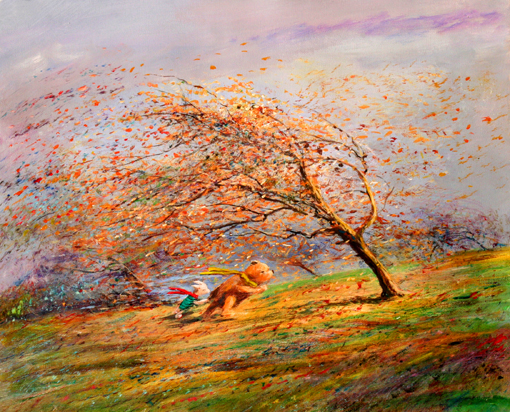
The wind has just been out of hand these last couple of days.  When you go outside, it’s like a bully pushing you down.  At night, it howls and shakes the house, and even after living in that house for 20 years, I’m afraid we’ll end up in Kansas.  Or Oz.  My husband has used the snowblower on the driveway four times in the last three days, and our vehicles have been stuck in the driveway at least twice.  Once a car wouldn’t start due to battery issues.

As a kid, I had a very romantic notion of the wind from children’s books.  Winnie the Pooh and The Wind the Willows.  Such beautiful illustrations. Funny and touching. 

But southern Wyoming has the highest sustained winds in the continental United States.  That’s why we have such a burgeoning industry of wind farms.  It’s due the venturi effect, where the mountains squeeze toward each other like a garden hose and shoot the air through. 

But this morning is calm and sunny and people are out shoveling their walks.  A wonderful calm after the storm.  So in honor of our frequent visitor, here’s Percy Bysshe Shelley’s "Ode to the West Wind."

Ode to the West Wind


I

O WILD West Wind, thou breath of Autumn's being
Thou from whose unseen presence the leaves dead
Are driven like ghosts from an enchanter fleeing,

Yellow, and black, and pale, and hectic red,
Pestilence-stricken multitudes! O thou
Who chariotest to their dark wintry bed

The wingèd seeds, where they lie cold and low,
Each like a corpse within its grave, until
Thine azure sister of the Spring shall blow

Her clarion o'er the dreaming earth, and fill
(Driving sweet buds like flocks to feed in air)
With living hues and odours plain and hill;

Wild Spirit, which art moving everywhere;
Destroyer and preserver; hear, O hear!

II

Thou on whose stream, 'mid the steep sky's commotion,
Loose clouds like earth's decaying leaves are shed,
Shook from the tangled boughs of heaven and ocean,

Angels of rain and lightning! there are spread
On the blue surface of thine airy surge,
Like the bright hair uplifted from the head

Of some fierce Mænad, even from the dim verge
Of the horizon to the zenith's height,
The locks of the approaching storm. Thou dirge

Of the dying year, to which this closing night
Will be the dome of a vast sepulchre,
Vaulted with all thy congregated might

Of vapours, from whose solid atmosphere
Black rain, and fire, and hail, will burst: O hear!

III

Thou who didst waken from his summer dreams
The blue Mediterranean, where he lay,
Lull'd by the coil of his crystàlline streams,

Beside a pumice isle in Baiæ's bay,
And saw in sleep old palaces and towers
Quivering within the wave's intenser day,

All overgrown with azure moss, and flowers
So sweet, the sense faints picturing them! Thou
For whose path the Atlantic's level powers

Cleave themselves into chasms, while far below
The sea-blooms and the oozy woods which wear
The sapless foliage of the ocean, know

Thy voice, and suddenly grow gray with fear,
And tremble and despoil themselves: O hear!

IV

If I were a dead leaf thou mightest bear;
If I were a swift cloud to fly with thee;
A wave to pant beneath thy power, and share

The impulse of thy strength, only less free
Than thou, O uncontrollable! if even
I were as in my boyhood, and could be

The comrade of thy wanderings over heaven,
As then, when to outstrip thy skiey speed
Scarce seem'd a vision—I would ne'er have striven

As thus with thee in prayer in my sore need.
O! lift me as a wave, a leaf, a cloud!
I fall upon the thorns of life! I bleed!

A heavy weight of hours has chain'd and bow'd
One too like thee—tameless, and swift, and proud.

V

Make me thy lyre, even as the forest is:
What if my leaves are falling like its own?
The tumult of thy mighty harmonies

Will take from both a deep autumnal tone,
Sweet though in sadness. Be thou, Spirit fierce,
My spirit! Be thou me, impetuous one!

Drive my dead thoughts over the universe,
Like wither'd leaves, to quicken a new birth;
And, by the incantation of this verse,

Scatter, as from an unextinguish'd hearth
Ashes and sparks, my words among mankind!
Be through my lips to unawaken'd earth

The trumpet of a prophecy! O Wind,
If Winter comes, can Spring be far behind?

February 16, 2012

"When I Consider How My Light Is Spent," by John Milton

To follow up on yesterday's post, this lovely poem.


Sonnet 19


When I consider how my light is spent,
Ere half my days, in this dark world and wide,
And that one talent which is death to hide
Lodged with me useless, though my soul more bent
To serve therewith my Maker, and present
My true account, lest He returning chide,
“Doth God exact day-labour, light denied?”
I fondly ask; But patience, to prevent
That murmur, soon replies “God doth not need
Either man's work or his own gifts. Who best
Bear His mild yoke, they serve Him best. His state
Is kingly: thousands at His bidding speed
And post o'er land and ocean without rest;
They also serve who only stand and wait.”